Wednesday, September 19, 2012

Vista Cabin

Earlier this year I had a number of drawing projects.  Here is one with pictures of the progress.


Loft Deck View

The Loft


Sunday, January 22, 2012

Cabin videos

Building our way to a dream come true.


Part 2


A few highlights from 2011


Monday, September 27, 2010

Little Cabin building Seminar

I've had the pleasure of working with a number readers of this blog on their own projects via email and phone calls.  I'm discovering a few areas in the construction process that seem to universally trip up those building for the first time.  A suggestion was made that I do a seminar - supposing there would be enough interest, to demonstrate some of the more advanced techniques.

We're in the early stages but the plan is to find a little house project and work with the owner/builder with the attendees present and chipping in where possible. Ideally it would be in an area convenient to the most participants, good access, nearby lodging/camping, be small enough to be completed in 2-3 days.

Topics we are considering covering
-Tools for remote building and their safe use
-Post and Pier foundations
-Framing Layout and assembly techniques
-Roof framing (this is where most stumble)
-Door and Window installation

If you have a project that you would like some free skilled and apprentice help with send me a note and we'll explore the possibility. 

Wednesday, June 16, 2010

Yonderosa Outpost Update

Progress was made on our last visit to the Outpost.

The Interior finish is showing real promise.


The exterior too!

Tuesday, June 1, 2010

Bear Camp Update

Last year I had the pleasure of working with CM to modify a version of the 'Outpost' into something that better suited his needs.  Now that the snow has retreated he's underway and off to a good start.
The 'Bear Camp' is structurally based on the 'Outpost' but encloses the porch and will add a full length covered porch on one side. 

I'm excited to see this one (and the others) progress.  I'll post pictures when I get them with the permission of the owners.  The 'Outpost' and its variations have licensed owners in a half dozen states now (FL, WA, OR, CA, TX and AZ) and so far the feedback has been good and the modifications give each one its own individual flavor.


Thanks to everyone for their interest.

Sunday, May 30, 2010

"Ain't as good as I once was...."

"... but I'm as good once as I ever was."

It's been a while since I framed anything this size.  This economy has got me back "wearing the tools" during more phases of the project than usual.  It's been enjoyable,  I surprised how much heavier everything feels compared to way back when I did this regularly.  Body held up OK but it did complain some.

It's taking shape, here's a long overdue update;

Sunday, March 7, 2010

Soft Cut Saw - Crack mitigation

It is pretty much impossible to make a slab completely crack free, the bigger it is the more likely it will crack.  Even loading it with steel won't prevent it.  Finding the real world balance, good fill, steel, good mud and some kind of joint seems to mitigate the bad ones.  At minimum I use tool joints but that isn't compatible with a power troweler.  With a slab this big (2100 sf) we opted for cut joints.

Slab Day

Concrete finishing is more of an art than a science.  There are a lot of guys that can do it and only a few that can do it well.  The extra $0.50 a foot for the good ones is WELL worth it.

Underslab Prep


Next stage is code compliance - thermal break, slab insulation, Plumbing ground work and steel. 

Tip: ALWAYS double check your plumbers work!  I checked his locations but didn't check his flange heights.  I don't know what it is about plumbers but NEVER seem to get the flange height right.  I even gave him a grade stake then falsely assumed (Assume = make an ASS out of U and ME) he knew how to use it...  He ended up being 3" LOW!!!  Should have babysat him - more work and expense.

Backfill

 
This site is about as perfect as they come.  Easy to move the machines around, great local material and generally flat.

 
Backfill required more than 200 yards of compactible fill.  We had plenty, it was nearby it only cost machine time!  Typically the old building Dirt axiom is You pay (a lot) when you need it and you pay (a lot) when you have too much to get rid of it."  That seems to be true most of the time in my experience.
  
We backfilled in 8" lifts compacting with three passes (minimum) as we went.  Makes for a long day but in the end you can drive your truck on it and it doesn't even leave a track.

 
We ran out of light on the first day and finished up by lunch the next.  


Wednesday, February 24, 2010

Breaking Ground, finally

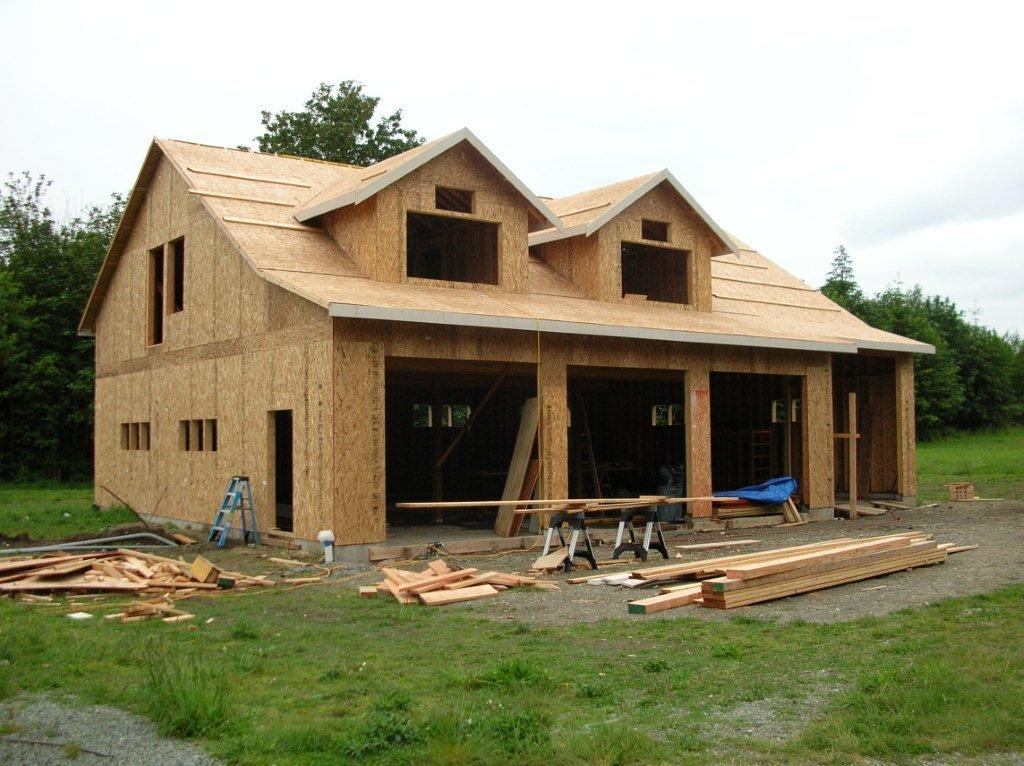
Garage-Shop with 980 sf residence above

The day we break ground on a new project is one of my favorites.  When things go well its even better.  This project is one of those that feels especially nice to be underway.

Finally off the drawing board and through the permit process - this county added a whole new layer of bureaucracy that I haven't had to deal with before here...  These days it doesn't matter if how good your land is, if your neighbor has a well or wetlands or has designated habitat or septic system or any kind or County recognized designation requiring a buffer, that buffer extends onto your property too.  Essentially, you need to consider not only the building conditions of your own property you must also consider all of the surrounding properties.  If during any part of the permit process anyone finds a Bigfoot (Sasquatch) track in the vicinity that whole area can be considered habitat or a corridor and the bureaucrats can proclaim your property to be unusable (worthless) and  still tax you as if you could build on it.  I can understand the purpose but giving one person that much control to make black and white decisions in gray areas is going to make a rocky road rougher.  Unless you have money to fight it (yes money talks loudly to government - I see it over and over), you are saddled with whatever that bureaucrat says you can do.

Anyway, we can finally put the spurs to it!!!

Thursday, January 28, 2010

Drawers


Baltic Birch Plywood makes a pretty nice drawer.  Only about 20 more to build...  Good problem.

Saturday, January 2, 2010

Mini Project - 36" vanity


This is one stout little cabinet.

Sunday, December 6, 2009

Permaculture Residence

An intriguing opportunity to design a  Permaculture Residence has come my way.  Among the challenges are incorporating a cook stove that will also be utilized to heat water (Thermosyphon).  My goal is to create a design that does not compromise kitchen efficiancy or complicate plumbing while maintaining ease of fuel (wood) access and storage.

I would very much like hearing from those who have experience with wood burning cook stoves, what they liked, what they didn't and any other recommendations they might have.

I'm looking forward to seeing how this will evolve and will try to share the progress on this blog as it unfolds.


Sunday, November 22, 2009

Bear Camp


Last Summer C.M. contacted me about helping him with some plans for a remote property he owns.   The Yonderosa Outpost was close but needed some modifications to fit his site's orientation, the climate and various limitations.  With any luck he'll be pounding nails next Spring.


Monday, November 16, 2009

Tools

Description of common tools

DRILL PRESS:
A tall upright machine useful for suddenly snatching flat
metal bar stock out of your hands so that it smacks you in
the chest and flings your beer across the room, denting the
freshly-painted project which you had carefully set in the
corner where nothing could get to it.

WIRE WHEEL:
Cleans paint off bolts and then throws them somewhere under
the workbench with the speed of light. Also removes
fingerprints and hard-earned calluses from fingers in about
the time it takes you to say, 'Oh s h --'

SKILL SAW:
A portable cutting tool used to make studs too short.

ADJUSTABLE WRENCH:
Used to start
the process of rounding off bolt heads. Sometimes used in
the creation of knuckle
abrasions.

PLIERS:
Used to complete the process of rounding off bolt heads.
Sometimes used in the creation of blood-blisters.

BELT SANDER:
An electric sanding tool commonly used to convert minor
touch-up jobs into major refinishing jobs.

HACKSAW:
One of a family of cutting tools built on the Ouija board
principle. It transforms human energy into a crooked,
unpredictable motion, and the more you attempt to influence
its course, the more dismal your future becomes.

VISE-GRIPS:
Generally used after pliers completely round off bolt
heads. They can also be used to transfer intense
welding heat to the palm of your hand.

OXYACETYLENE TORCH:
Used almost entirely for lighting various flammable objects
in your shop on fire. Also handy for igniting the grease
inside the wheel hub out of which you want to remove a
bearing race.

TABLE SAW:
A large stationary power tool commonly used to launch wood
projectiles for testing wall integrity.

HYDRAULIC JACK:
A tool used for
raising a car to change a flat tire that seldom
fits under a car with a flat
tire.

HYDRAULIC FLOOR JACK:
Used for lowering an automobile to the ground after you
have installed your new brake shoes, trapping the jack
handle firmly under the bumper.

BAND SAW:
A large stationary power saw primarily used by most shops
to cut good aluminum sheet into smaller pieces that more
easily fit into the trash can after you cut on the inside of
the line instead of the outside edge.

TWO-TON ENGINE HOIST:
A tool for testing the maximum tensile strength of
everything you forgot to disconnect.

PHILLIPS SCREWDRIVER:
Normally used to stab the vacuum seals under lids or for
opening old-style paper-and-tin oil cans and splashing oil
on your shirt; but can also be used, as the name implies, to
strip out Phillips screw heads.

STRAIGHT SCREWDRIVER:
A tool for opening paint cans. Sometimes used to convert
common slotted screws into non-removable screws and
butchering your palms.

WIRE CUTTERS:
Handy
for cutting wires and zip ties.. Can also be used to
determine the presence of electricity.

PRY BAR:
A tool used to crumple the metal surrounding that clip or
bracket you needed to remove in order to replace a 50 cent
part.

HOSE CUTTER:
A tool used to make hoses too short.

HAMMER:
Originally employed as a weapon of war, the hammer nowadays
is used as a kind of divining rod to locate the most
expensive parts adjacent the object we are trying to hit.

UTILITY KNIFE:
Used to open and slice through the contents of cardboard
cartons delivered to your front door; works particularly
well on contents such as seats, vinyl records, liquids in
plastic bottles, collector magazines, refund checks, and
rubber or plastic parts. Especially useful for slicing work
clothes and fingers, but only while in use.
DAMMIT TOOL:
Any handy tool that you grab and throw across the garage
while yelling 'Dammit' at the top of your
lungs. It is also, most often, the next tool that you
will need.

Saturday, October 17, 2009

Tuesday, September 22, 2009

Thursday, September 17, 2009

Murphy Bed

The Murphy Bed is a good solution for a small multi-purpose space. A comfortable sleeping space requires only around 5 feet of wall and 16" of floor space for a full sized bed.


I purchased the hardware from www.wallbed.com and I used plywood and solid stock that I had on hand. The joinery is simple and does not require shop sized equipment - though it does make it easier if you have a table saw. The hardware is good quality. The pistons make raising and lowering the bed very easy. The latching system is crude but effective. Of the commercially available hardware I've found I believe this is the best. I would recommend it.